
How Interview Analysis Works
Understanding Malia's structured interview evaluation methodology, scoring framework, and how to interpret candidate analysis reports.
Overview
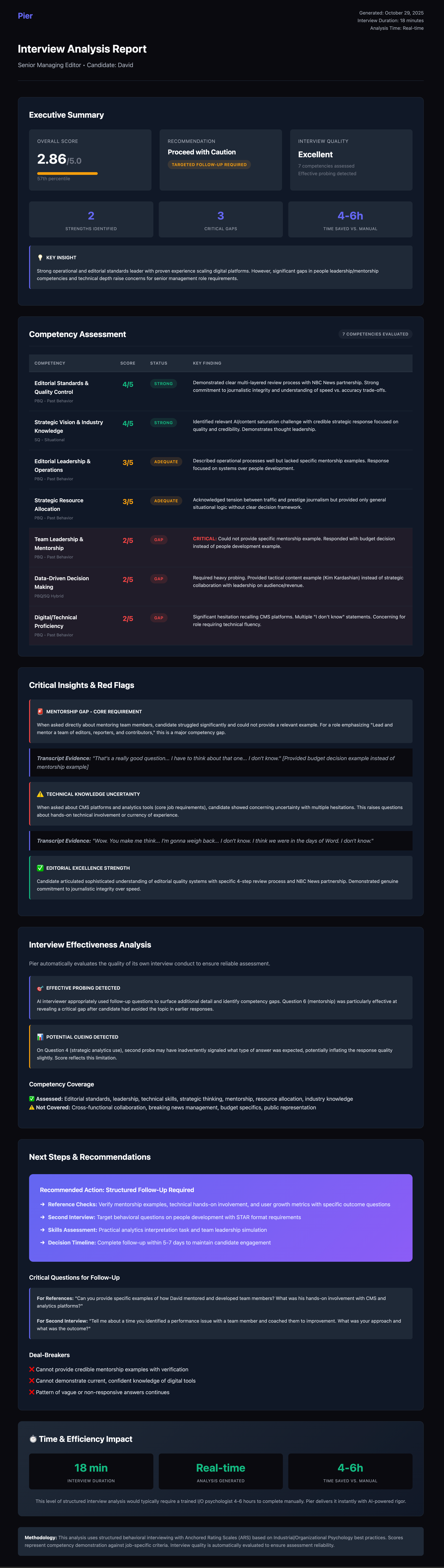
This guide explains the professional standards and assessment framework underlying our Structured Interview Analysis reports. It is intended to help talent, hiring, and compliance stakeholders evaluate the soundness of the methods and interpret reports consistently.
What the Report Provides
- Structured, competency-based evaluation of interview responses
- Per-question ratings with written rationales
- Consolidated profile of strengths, development areas, and recommended follow-ups
- Interview-quality checks relevant to fairness and evidence integrity
Assessment Framework
Our approach follows established Industrial/Organizational (I/O) psychology practices for structured employment interviews.
Competency Model (KSAOs)
Each role is anchored to a competency profile covering Knowledge, Skills, Abilities, and Other job-relevant characteristics.
- Interview questions are mapped to these competencies to ensure job-relatedness
Question Types
Past-Behavioral Questions (PBQs): Elicit specific prior situations, actions, and results to assess behavioral consistency.
Situational Questions (SQs): Present structured hypotheticals to assess decision quality and job knowledge.
Anchored Rating Scales (ARS)
Each question is scored on a 1–5 scale with behavioral anchors defining the hallmarks of weak, acceptable, and strong responses.
- Anchors emphasize observable evidence (specificity, appropriateness of actions, linkage to outcomes) aligned to the target competency
Per-Question Scoring with Rationale
Raters compare each response to the relevant anchors and record a short evidence-based rationale before any roll-ups.
- This creates traceability from evidence → anchor → rating
Interview-Quality Checks
- Follow-up questions (probing) are reviewed and categorized as planned/neutral or potentially leading
- Notes on probing help readers understand whether any response may have been shaped by interviewer prompts
Impression-Management Notes
The report flags responses that appear vague, inflated, or unsupported versus responses that provide concrete, verifiable detail.
How to Read the Report
Executive Summary: Overall rating, recommendation, and a synopsis of strengths and risks.
Competency Assessment: For each competency, a score (1–5), a status label (e.g., Strong/Gap), and a concise evidence summary.
Critical Insights: Key excerpts or patterns that materially affect risk or confidence.
Interview Effectiveness: Observations on probing and coverage to inform fairness/readability.
Next Steps: Structured reference prompts, targeted follow-up questions, and role-relevant work samples.
Interpreting Scores
Score Legend
- 5/5: Specific, relevant examples; appropriate actions; clear linkage to outcomes strongly aligned to the competency
- 3/5: Partially specific; some alignment; actions or outcomes moderately evidenced
- 1/5: Vague or off-target; little to no actionable evidence
Recommendation: Emphasize patterns across questions/competencies over single isolated responses.
Evidence Standards, Validity, and Reliability
Job-relatedness: Questions and scoring criteria are tied to documented competencies for the role.
Content validity: Behavioral anchors reflect the domain behaviors expected for the competency and question type.
Process reliability: Per-question anchors and written rationales support consistent ratings and enable calibration.
Fairness safeguards: Probing review and impression-management notes provide context to mitigate bias and over-interpretation.
Where organizations maintain established competency models and interview guides, the method aligns directly with those artifacts. Where such materials are still maturing, the same framework provides structure and transparency to support incremental adoption.
Recommended Complementary Steps
Structured references: Behaviorally anchored prompts that mirror the assessed competencies.
Role-relevant work samples: Practical tasks (e.g., analysis, judgment, leadership simulation) targeting identified gaps.
Panel calibration: Optional dual-review and brief reconciliation to enhance consistency on higher-stakes roles.
Governance & Responsible Use
Reports provide decision support and are intended to be used alongside organizational policies, local regulations, and professional judgment.
Documentation (scores + rationales + notes) is designed to support auditability and compliant record-keeping.
Glossary
KSAO: Knowledge, Skills, Abilities, and Other characteristics.
PBQ: Past-Behavioral Question (“Tell me about a time…”).
SQ: Situational Question (“What would you do if…”).
Anchored Rating Scale (ARS): A scale with behavioral examples defining each score point.
Probing: Interviewer follow-ups; categorized for neutrality versus potential cueing.
Impression Management: The candidate’s self-presentation; flagged when evidence quality is weak.
Still Have Questions?
We’re here to help! Schedule a demo with our team to get personalized answers to your questions.
Ready to transform your recruiting process?
See how Malia can help you save 15+ hours per week and only interview pre-qualified candidates.